



Expert Insight: Is Your DPF Getting a Quality Clean?
All about the thermal DPF cleaning process.
As the price of OEM aftertreatment parts continues to skyrocket, fleets and owner-operators have learned how to extend the life of their equipment by educating themselves. DPF Cleaning is one of those services that has offered great savings for customers, but I’ve noticed that some folks don’t completely understand the DPF cleaning process.
My name is Nadjara, Sales Manager for REP, and as an Experienced DPF Cleaner, I plan to “pull back the curtain” on the thermal DPF cleaning process so you can better gauge who is offering you a quality service and who is taking advantage of unsuspecting customers.
Key Takeaways:
- DPF cleaning is necessary because ash — unlike soot — cannot be removed by a regen and will eventually restrict the filter.
- The industry standard is thermal cleaning, also known as the “Pulse, Bake, Pulse” or “Bake & Blow” method.
- A flow test before and after cleaning is the only reliable way to confirm a filter has actually been cleaned.
- Shops that skip the baking step and only de-ash are offering an incomplete service in most cases.
- Before-and-after documentation, including photos and a cleaning report, is a mark of a quality cleaning service.
- Cordierite and Silicon Carbide DPFs require different temperature profiles — proper equipment accounts for this automatically.
Why Does A DPF Need To Be Cleaned?
A byproduct of today’s diesel combustion is a black particulate known as soot. This harmful pollutant can contribute to illnesses such as cancer, which is why it’s important to prevent it from entering the atmosphere. That’s what these aftertreatment systems are designed for, and they do an amazing job of managing pollutants. It’s even been said that the air coming out is cleaner than the air going in.

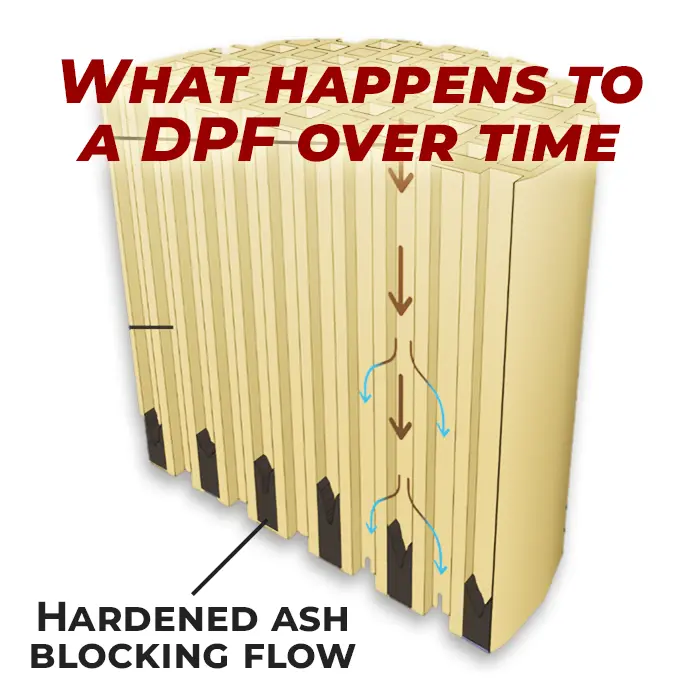
The soot/ash is stored in the cells of the DPF filter or “trap,” and over time, those cells fill up, and the backpressure rises. The system recognizes this and triggers a Regen. This signals the engine to dose fuel into the exhaust. The DOC (Diesel Oxidation Catalyst) reacts with the fuel, raising the temperature of the DPF upwards of 1,000 degrees Fahrenheit. This oxidizes the soot/ash, leaving behind the inorganic matter — much like charcoal turning to ash on a grill. This process drops the backpressure back to operating range and keeps you on the road longer.
There comes a point when the DPF gets too clogged with ash/inorganic matter, and the DPF loses efficiency. Once this happens, no number of Regens will do much. The DPF has to be removed and either cleaned or replaced. With OEM DPFs being upwards of $3k, we recommend going with the cost-effective option and cleaning your DPF, but how is that done?

Thermal DPF Cleaning Process
There are a few DPF cleaning processes out there, but the industry standard and most common is Thermal Cleaning, also referred to as “Pulse, Bake, Pulse” or “Bake & Blow” method. This is the method I have spent years using and would recommend to most customers.
As with cleaning processes, there are many systems out there, like our Filtertherm Thermal system, but no matter the equipment, all should follow similar principles to our 8 Step Process. We break them up into 3 Stages.
Stage 1: Pre-Clean
Step 1: Inspection
Before cleaning any filter, I perform a thorough inspection. This ensures the integrity of the filter before wasting time and money on cleaning. Another benefit is that it allows us to check for oddities, like moisture or oil. If a DPF in this condition is baked, it can cause damage to the filter or, worse, catch fire in the equipment.

A visual inspection, followed by a probe or pin test, is what we recommend. We are looking for cracked brick, cells that are “hard-packed” (these are cells where ash binds to the cell wall, blocking the cell), and/or possible moisture.
Once visual inspection is done, filters are weighed, and a restriction test that we call a “flow test” is done. I cannot stress this enough…A quality flow reading is the easiest way to gauge how clean a filter is.
Without this test, no one can reliably say your filter has been cleaned, and you could possibly still have particulate trapped in your filter. If you want a step-by-step guide on inspecting a filter, please refer to this helpful video.

Step 2: Document
We take the info gathered from our inspection and document it. This helps protect shops but also gives key insights to customers on the shape a DPF arrived in. This is a pretty straightforward step, so I won’t go into detail, but I recommend choosing a DPF cleaning service that offers before and after photos at a minimum.
Step 3: De-ash
The next step in the process is de-ashing the filter or “blowing out” the filter. There are many ways this can be done, but the way we do it is with our Filtertherm Pulse Cabinet. This is a contained, hands-free option that builds up air pressure and disperses it in “pulses” over the face of the filter to deposit the soot in a chamber at the bottom. Usually, the process takes 20 minutes or so, but in the cases of heavily sooted filters, it can take a bit longer.
Light-duty filters can be a bit trickier (and dirtier). Due to the odd shapes, I would opt for our Remote Dust Collection Kit, which uses a vacuum to suck in the soot as you blow it out with a hand tool. It wasn’t the cleanest way of cleaning a filter, but it was effective nonetheless.

Some shops stop at this step, deeming the filter “clean enough” to go back into operation. While there can be some cases made for this approach, from my experience, there is little reason not to bake the filter unless the customer is in a rush or the filter was not dirty enough for a clean to begin with. In those situations, I rely on the Flow Test as it is the best way of knowing whether that filter is clean enough to return to service. From there, we move on to the next stage.
Stage 2: Clean
Step 4: Bake
Once I have de-ashed the DPF, the next step is to bake the filter. Much like the regen, this oxidizes soot while also loosening up trapped ash. In all my years of cleaning, it is rare to bake a filter without seeing some additional ash deposited afterward.
The filter portion of DPFs is constructed from different materials, with the most common “tan brick” being Cordierite and the “blue checkered brick” being Silicon Carbide. The difference when referring to DPF cleaning is how much heat it can withstand. Cordierite can withstand temperatures up to 1,200 degrees without degrading, while I have seen Silicon Carbide handle almost 1,400 degrees Fahrenheit.

To provide context to these numbers, soot oxidizes at 1,000 – 1,200 degrees Fahrenheit. So the more heat a DPF filter can withstand, the easier it is for soot to oxidize into ash. I know what you are thinking, “Then why aren’t all DPFs Silicon Carbide since they can handle higher temperatures?” It simply comes down to price and flexibility.
Silicon Carbide can withstand more heat but is brittle in larger surface areas. That is why they are manufactured in checkered patterns for increased durability. Cordierite, on the other hand, remains durable in larger surface areas and, more importantly, is also cheaper.
The Filtertherm DPF Oven has Temperature profiles that make it easy, allowing you to choose the material and start the process. I’m not sure about other systems, but Filtertherm bakes filters for 6-8 hours with an 18-hour cooling period, usually done during the closed hours of business.

Step 5: Cool
Once the DPF oven gets to a safe temperature, you can crack the door open and allow the ambient air to cool down the oven. From there, the DPF filters are placed on the Filtertherm Cooling Cart to speed up the cooling process. Now the filter is ready for the final de-ashing.
Step 6: De-ash
This step is necessary because the DPF will release more ash after being baked. Similarly to step 3, we de-ash the filter again, hence the “Pulse, Bake, Pulse.”
During de-ashing, pay attention to the color of the ash. White / Grey ash is a good sign, but in the case of a heavily sooted filter, there might be signs of black soot still in the filter. If this happens, I recommend finishing the de-ashing and running a flow test. If the flow reading is not within the operational range, the filter should be baked again to oxidize any remaining soot and ensure a thorough cleaning. Below is an example of our Flow Reference tool.

Stage 3: Post Clean
Step 7: Inspect
If everything went well in the previous step, I will perform a final inspection, take a flow reading, and weigh the filter. The goal is to determine what changed/improved from the first inspection. Some things to keep an eye out for are shifting of the brick due to loose packing material and/or deterioration of the brick.
If your filter had Hard Pack during the first inspection, do another probe/pin test to see if the hard pack has loosened. One of the benefits of the Filtertherm Pulse machine vs other equipment is its ability to loosen hard-packed ash. The force generated from the pulses can loosen the hard-packed ash and possibly recover those lost cells.
Step 8: Document
Just like step 2, we document our findings, take “after” pictures, and generate a copy of the cleaning report for the customer. Fleet owners and managers appreciate these reports because they clearly demonstrate the effectiveness of the cleaning. Additionally, these reports can help them to understand the condition of the DPF filter, so they are better prepared rather than taken by surprise should a filter need to be replaced.
If you’re not cleaning your own filters, I recommend choosing a shop that provides detailed reporting, as it will help you better manage maintenance expenses. If you are a shop looking for an easy-to-use reporting software, check out Filtertrak. It’s what we use at all our cleaning locations, and the customers love it!

Conclusion
There are various types of DPF Cleaning equipment out there, but no matter what the system, the process should look generally the same. There should be an inspection of the filter, a de-ashing of the filter, a process of removing trapped soot/ash, and a final inspection. I hope this pulls back the curtain on DPF cleaning and shows how straightforward the process really is.
If you want to see how the different cleaning methods compare, check out this article on Thermal vs Aqueous vs Ultrasonic.
If you have any questions about DPF cleaning or want to learn more about what we offer at REP, don’t hesitate to reach out — I’m happy to help.

Q: How often does a DPF need to be cleaned?
A: Cleaning intervals vary by application and duty cycle, but most commercial diesel vehicles require a DPF cleaning every 100,000–200,000 miles, or when the filter can no longer be cleared by a regen cycle.
Q: What is the “Pulse, Bake, Pulse” DPF cleaning method?
A: It refers to the three-stage thermal cleaning process: a pre-clean de-ashing (pulse), a high-temperature bake to oxidize trapped soot into ash, and a final de-ashing pass (pulse) to remove the newly released ash.
Q: How do I know if my DPF was actually cleaned properly?
A: A reputable cleaning service will provide a before-and-after flow test reading, photos, and a cleaning report. The flow reading is the most objective measure of whether a filter is clean enough to return to service.
Q: What is the difference between soot and ash in a DPF?
A: Soot is a combustion byproduct that can be oxidized and removed by a regen or baking. Ash is the inorganic residue left behind after soot is oxidized — it cannot be removed by a regen and must be physically extracted through cleaning.
Q: Is it better to clean or replace a DPF?
A: Cleaning is almost always the more cost-effective option. OEM DPF filters can cost $3,000 or more, while professional cleaning is a fraction of that cost — provided the filter is not physically damaged.
Q: What is a DPF flow test?
A: A flow test measures the restriction level of a DPF filter, indicating how freely exhaust can pass through it. It is the most reliable way to benchmark a filter’s condition before and after cleaning.
Want to find out more about becoming a Redline Emissions Products® dealer? Call 888-295-4670 and get in touch with our team. Nadjara is happy to answer any questions you may have.
Need Tech Support or need help troubleshooting a DPF problem? Contact REP Support at 1-888-564-4209
Like this content? Be sure to like and follow our social media pages. Message us and we’ll return the favor!